 SleepBestie
How Accurate Is Apple Watch Sleep Tracking?
Apple Watch offers a useful view of your sleep, but accuracy depends on what is being measured. Here is what the research means for your nightly report.
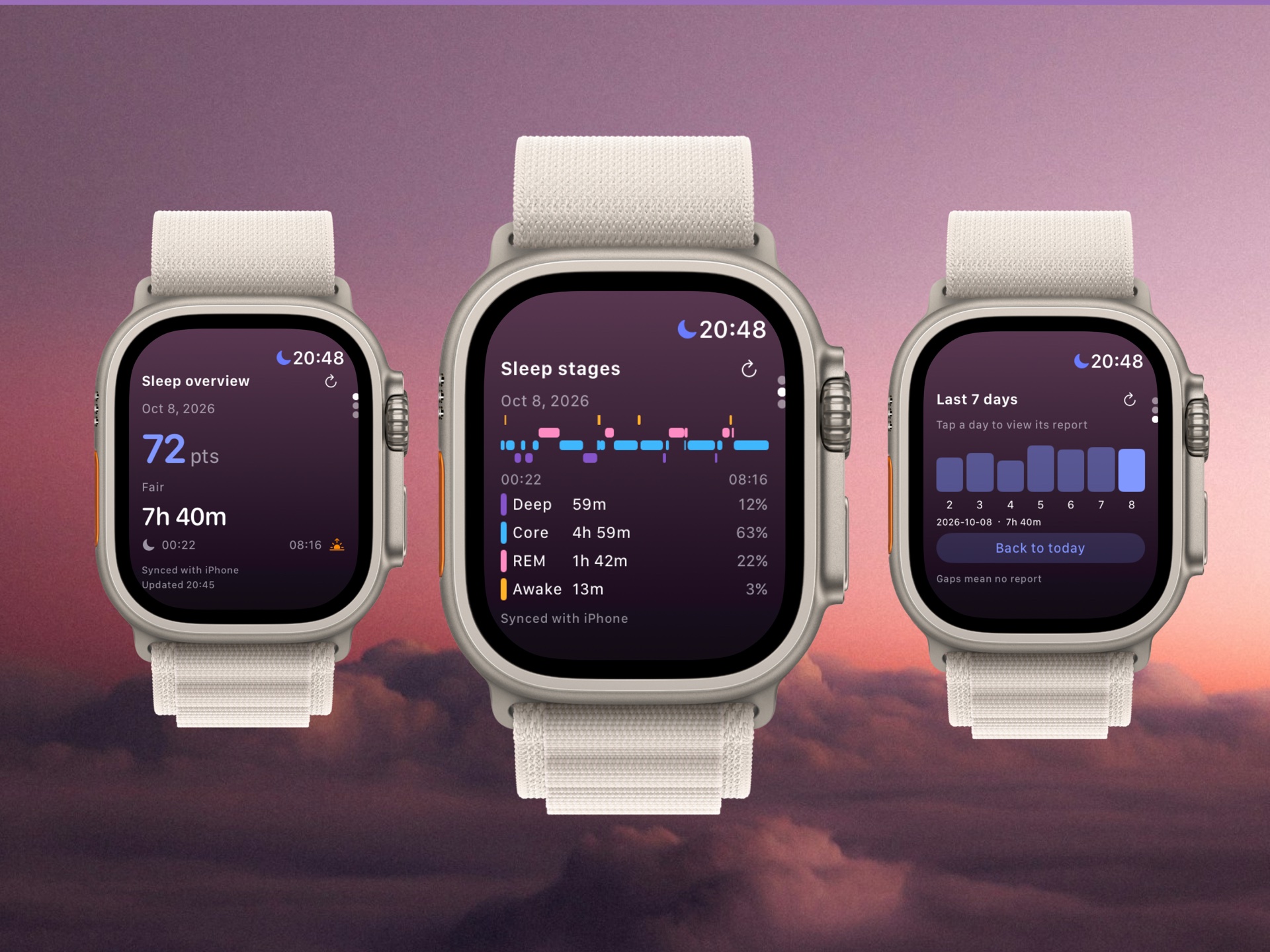
SleepBestie screens are shown for illustration. The scores and stage durations are example app data, not research findings or recommended targets.
Apple Watch can help you see when you tend to sleep and how your routine changes. It is less dependable at spotting quiet wakefulness or identifying every sleep stage. The useful question is not simply whether the watch is accurate, but which parts of the report can guide everyday decisions. [Schyvens 2025 SLEEP Advances] [Lambe 2026 npj Digit Med]
Accuracy depends on what you are measuring
Validation studies commonly compare a watch with polysomnography (PSG), which records brain activity, eye movements, muscle activity and other signals. A watch estimates sleep from signals at the wrist. Getting the total sleep duration close to PSG does not necessarily mean it has identified the right stage at every point in the night. [Schyvens 2025 SLEEP Advances]
Sleep sensitivity is the proportion of PSG-confirmed sleep that the watch correctly labels as sleep. Wake specificity is the proportion of PSG-confirmed wakefulness it correctly labels as awake. Neither tells you how accurately every stage is identified. Kappa is another measure: it describes agreement beyond what would be expected by chance, rather than a percentage of correct readings.
How Apple Watch estimates sleep stages
Apple’s technical report describes an algorithm that uses three-axis accelerometer data to classify 30-second segments as Awake, REM, Deep or Core. These signals include subtle movements as well as larger ones. Core combines clinical stages N1 and N2; Deep corresponds to N3. The watch does not measure brain waves to make these classifications. [Apple Sleep Stages PDF]
Before interpreting a change, check that Track Sleep with Apple Watch is enabled and that the band fits comfortably and securely. Apple notes that a loose fit can register extra movement. Consistent setup and wear help you avoid confusing a recording issue with a change in sleep. [Apple Support Sleep]
For a closer look at Deep, Core and REM, read our sleep stages guide.
It also matters which algorithm a study tested. Walch and colleagues used Apple Watch motion and heart-rate data to develop their own research models. Their findings should not be treated as a validation of Apple’s built-in Sleep Stages feature. [Walch 2019 SLEEP]
What studies find about sleep and wakefulness
Schyvens and colleagues compared several wearables with PSG. The Apple Watch Series 8 analysis included 20 successful recordings, with sleep sensitivity of 96.27% and wake specificity of 52.15%. In that sample, the watch identified most sleep segments but only about half of the awake segments. These results apply to the tested devices and software, not every Apple Watch version. [Schyvens 2025 SLEEP Advances]
In a study by Robbins and colleagues, the Apple Watch Series 8 analysis included 29 adults. Sleep sensitivity was about 97%, and sleep–wake labels agreed with PSG for about 93% of the 30-second segments. Overall agreement can be high when most of the night is spent asleep; it does not mean the watch captures every awakening. [Robbins 2024 Sensors]
If you remember lying awake while the chart shows sleep, the watch may have missed that period of wakefulness. Your recollection also has limits, but it is still useful context. Note the mismatch rather than assuming the chart must be right.
How reliable are Deep, Core and REM estimates?
Both studies found that Apple Watch Series 8 estimated less Deep sleep and more light sleep, corresponding to Core, than PSG. The average differences were about 25 minutes less Deep and 59 minutes more light sleep in Schyvens, and 43 minutes less Deep and 45 minutes more light sleep in Robbins. These are group averages, not amounts to add to or subtract from your report. [Schyvens 2025 SLEEP Advances] [Robbins 2024 Sensors]
Robbins reported a four-stage kappa of about 0.60. Agreement for nightly Deep and REM duration was poor by the study’s duration-agreement measure. A detailed timeline therefore should not be read as an exact account of how many minutes you spent in each stage. [Robbins 2024 Sensors]
Lambe and colleagues’ living systematic review also describes better performance for distinguishing sleep from wakefulness than for separating sleep stages, with deep sleep sometimes classified as light sleep. This helps explain a recurring limitation, but cannot tell you how much your own report is off on a particular night. [Lambe 2026 npj Digit Med]
What Apple’s own validation reports
Apple’s October 2025 report presents the original and updated algorithms separately. For the original algorithm, median sleep sensitivity was 97.9% and wake specificity was 75.0%. The updated algorithm’s corresponding figures were 96.8% and 78.9%, with median four-stage kappa of about 0.68. These are manufacturer validation results. [Apple Sleep Stages PDF]
The studies used different participants, testing conditions and software versions, so their percentages are not a simple ranking. Older studies also do not test every later software update. Apple’s results add useful evidence, while leaving the distinction between a wrist estimate and a clinical sleep study intact.
How to use the data in everyday life
Start with your sleep duration, schedule and patterns across several nights, alongside how rested you feel. Comparing last night with the previous seven days can provide context, but seven days is not a clinical cutoff. Looking at a week can make an unusual night less distracting; it does not cancel out a consistent measurement bias.
Keep track of relevant context, such as travel, alcohol, late caffeine, illness or taking the watch off overnight. If you try a small routine change, notice whether you feel better as well as what the chart shows. There is no need to chase someone else’s stage percentages.
When to seek medical advice
One low Deep-sleep estimate, without a change in how you feel, does not establish a sleep disorder. Persistent unrefreshing sleep, loud snoring, witnessed breathing pauses or marked daytime sleepiness are reasons to speak with a clinician, even if your report looks reassuring.
Sleep-stage tracking cannot diagnose or rule out sleep apnea. Apple’s separate sleep-apnea notification feature, where available, is designed to flag possible signs for medical follow-up, not provide a diagnosis. Not everyone with sleep apnea receives an alert, so ongoing symptoms still matter. [Apple Support Sleep Apnea]
How SleepBestie helps you read your sleep
SleepBestie uses sleep data recorded by your Apple Watch and synced to Apple Health to help you understand recent nights and personal trends. It requires an Apple Watch. Its analysis builds on the watch’s estimates; it does not independently verify sleep stages or diagnose sleep disorders.
Understand your sleep over time
Use SleepBestie to explore your recent sleep trends, then consider them alongside your routine and how you feel.
Download SleepBestieFrequently asked questions
Is Apple Watch as accurate as a sleep study?
No. Apple Watch estimates sleep from wrist sensor data. A clinical PSG study records brain activity and other physiological signals to assess sleep. The watch can provide useful context, but it is not a substitute for that assessment.
Why does my Deep sleep look low on Apple Watch?
Some studies found that Apple Watch estimated less Deep sleep and more Core-equivalent sleep than PSG. A low number may partly reflect that limitation, but it cannot tell you the cause on its own. Consider your recent pattern and how you feel. [Schyvens 2025 SLEEP Advances] [Robbins 2024 Sensors]
Can Apple Watch diagnose sleep apnea?
No. Neither the sleep-stage chart nor a separate sleep-apnea notification provides a diagnosis. A notification is a reason to seek medical assessment. Persistent symptoms also deserve attention, even if you have not received an alert.
Is a week of data more useful than one night?
Usually it gives more context about your routine. Compare several nights with how you feel, while remembering that repeated measurements can still share the same bias. More data does not make persistent symptoms less important.
This article is for general information, not medical advice or diagnosis. Consult a healthcare professional about persistent sleep symptoms.
Related reading
- Apple Watch sleep stages explained: Deep vs Core vs REM
- Understanding a low Deep-sleep estimate
- Why you may feel tired after a full night’s sleep
Sources / References
- [Apple Sleep Stages PDF] — Manufacturer validation, updated October 2025. Original and updated algorithms are reported separately.
https://www.apple.com/health/pdf/Estimating_Sleep_Stages_from_Apple_Watch_Oct_2025.pdf - [Apple Support Sleep] — Official sleep-tracking setup and fit guidance.
https://support.apple.com/en-us/108906 - [Schyvens 2025 SLEEP Advances] — Independent multi-device PSG validation; the Apple Watch Series 8 analysis had 20 successful recordings.
https://pmc.ncbi.nlm.nih.gov/articles/PMC12038347/ - [Robbins 2024 Sensors] — PSG comparison at Brigham and Women’s Hospital; the Apple Watch Series 8 analysis included 29 adults. Funded by Oura, with Oura advisory and consulting relationships disclosed by the lead author.
https://pmc.ncbi.nlm.nih.gov/articles/PMC11511193/ - [Walch 2019 SLEEP] — Research models built using Watch sensor data, rather than a test of Apple’s built-in sleep-staging algorithm.
https://pmc.ncbi.nlm.nih.gov/articles/PMC6930135/ - [Lambe 2026 npj Digit Med] — A living systematic review that brings together existing research, rather than a new overnight validation experiment.
https://www.nature.com/articles/s41746-025-02238-1